Repair TipsLocal Guides
How to dry out wet drywall after a leak in Chicopee Falls
Wet drywall in Chicopee Falls dries in 24 to 72 hours if you start now. Here is the exact process, the mold cutoff, and when to call us.
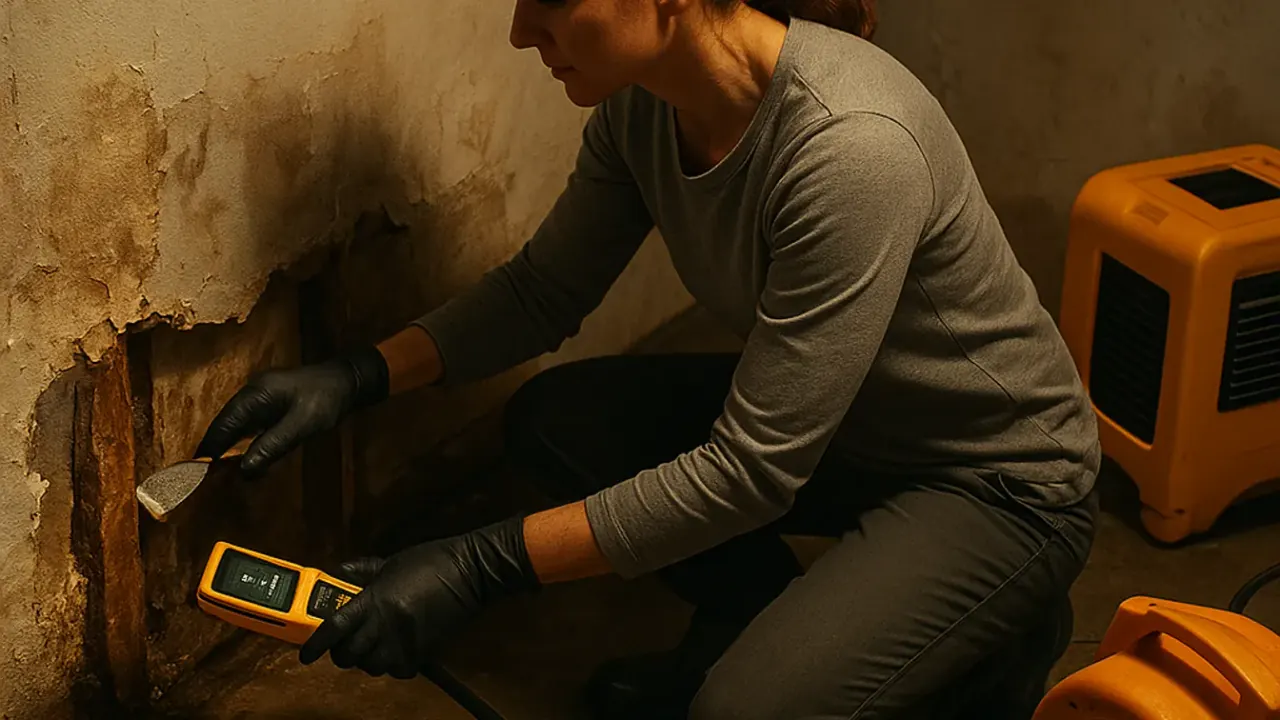
You can dry out wet drywall after a leak in Chicopee Falls by stopping the water, cutting away any soaked paper facing, and running air movement plus dehumidification until a moisture meter reads under 15 percent - usually 24 to 72 hours. If the drywall has been wet longer than 48 hours, or the leak came from a sewage line, the board comes out instead of drying. The rest of this post walks through the exact sequence we run in Chicopee Falls homes, the tools that matter, and the point where drying stops being cheaper than replacing.
How long wet drywall takes to dry in Chicopee Falls
Wet drywall in Chicopee Falls dries in 24 to 72 hours when you start within the first day and keep air moving the whole time. The clock starts the moment the leak begins, not the moment you notice the stain on the ceiling.
Drywall is gypsum sandwiched between two paper layers. The paper wicks water sideways faster than the gypsum core absorbs it, which is why a small drip behind a Chicopee Falls bathroom vanity can show up as a two-foot stain on the wall below. The core holds moisture longer than the surface feels wet.
Three things set your drying time: how much water got in, how thick the board is, and how much air you can push across it. Half-inch drywall on a ceiling dries slower than half-inch on a wall because gravity keeps water pooled against the paper. Five-eighths board - common in older Chicopee Falls houses - adds roughly 12 to 18 hours to the dry time.
Humidity matters more here than people expect. Chicopee Falls sits along the Chicopee River, and from late spring through early fall our indoor relative humidity often runs 55 to 70 percent without any help. A wet wall in that air will not dry - it will just sit there. You need the room below 45 percent RH before the board starts giving moisture back.
Step-by-step: how to dry out wet drywall after a leak in Chicopee Falls MA
How to dry out wet drywall after a leak in Chicopee Falls MA comes down to eight moves, done in order. Skip one and you either trap moisture or spread it.
- Shut off the water. Close the fixture valve or the main. A leak that keeps running makes every other step pointless.
- Kill the power to the wet zone. Water and a Chicopee Falls basement panel are a bad pair. Trip the breaker before you touch anything overhead.
- Photograph everything. Twenty photos on your phone, wide and close. Your insurer will ask, and so will we if you call.
- Pull furniture and rugs back 3 feet. Wet drywall releases moisture into whatever sits against it.
- Poke the board. Press a screwdriver into the wet area. If it sinks like wet cardboard, that section is gone - cut it out now rather than drying dead material.
- Score and remove soaked paper. Where the paper facing peels away from the gypsum, cut back to sound board with a utility knife. Leave a clean edge.
- Set air movement and dehumidification. One air mover per 10 to 15 linear feet of wet wall, plus a refrigerant dehumidifier rated for the room size.
- Meter it daily. A pin-type moisture meter at the same three spots every morning. You are watching the number fall, not guessing by touch.
If the leak came from a burst supply line rather than a slow drip, the volume is usually too high for a fan-and-wait approach. That is a job for pipe burst water removal Chicopee MA, where we extract standing water first and then dry the structure.
One more thing worth knowing: if the leak is under a sink or behind a toilet, the same moisture that wrecked the drywall is often sitting in the cabinet base and subfloor. We handle that as part of drywall water damage repair Chicopee MA, because drying the wall while the floor stays wet just means the stain comes back in six weeks.
What tools actually move the needle
Three tools do almost all the work when you dry wet drywall in Chicopee Falls: air movers, a dehumidifier, and a moisture meter. Everything else is optional.
Air movers. A standard 1/3-horsepower blower moves about 2,500 CFM. You want the airflow angled along the wall surface, not straight into it - the goal is to scrub the wet face with moving air, which speeds evaporation by roughly 3 to 5 times versus still air.
Dehumidifier. A 50-pint refrigerant unit handles a single room up to about 1,200 square feet. In a Chicopee Falls basement in July, you may need two. Empty the bucket or run a hose to a drain - a full unit shuts off and you lose hours.
Moisture meter. Pin-type meters run $40 to $120 at any hardware store. This is the only way to know when you are done. Drywall reads dry to the touch at 20 percent moisture content and is still a mold risk. You want under 15 percent, ideally 12.
- Run the equipment 24 hours a day, not just when you are home.
- Keep interior doors open so air can circulate through the whole floor.
- Close windows. Pulling in Chicopee Falls summer air at 70 percent humidity undoes your dehumidifier.
- Point one blower at the base of the wall where water pooled.
Expect to spend $150 to $400 renting this setup for a weekend, or $0 if you call us and we bring ours. Typical 2026 pricing in this area for a full professional dry-out of one room runs $900 to $2,200 depending on square footage and how much board has to come out.
When wet drywall cannot be saved
Wet drywall cannot be saved once the paper facing has separated from the gypsum core, once mold has colonized the back side, or once the board has been wet more than 48 hours in a humid space. Cut it out and replace it.
Mold is the real deadline. Given moisture and a food source - and drywall paper is a food source - mold spores germinate in 24 to 48 hours. By day three you can have visible growth on the back of the board, which you will not see from the room side. That is why we meter and, when needed, open a small inspection hole rather than trusting appearances.
There is also a structural line. Drywall that has sagged more than about a quarter inch over a ceiling span has lost its integrity and will not flatten back out. Same for board that crumbles when you press it. Both get replaced, not dried.
If the water carried sewage - a backed-up floor drain, a toilet overflow from the stack - the board is contaminated regardless of how long it has been wet. That is a tear-out plus disinfection, which is what our sewage backup cleanup Chicopee MA crews do.
Common mistakes we see in Chicopee Falls homes
The most common mistake is running a fan without a dehumidifier. You evaporate water into the air, the air saturates, and the wall stops drying. Both machines or neither.
Second: painting over it. A coat of primer on a wall reading 22 percent moisture traps the water behind a sealed film. The paint blisters within weeks and you are back to square one, minus the cost of the paint.
Third: assuming the leak is where the stain is. Water travels along framing and joists. In the triple-deckers and older two-families around Chicopee Falls, we routinely trace a ceiling stain back to a second-floor supply line 12 feet away. Chase the moisture with a meter, not with your eyes.
Fourth: skipping the exterior. If the leak came in through a window or a roof penetration during a storm, drying the inside without fixing the entry point means the next rain starts the whole cycle again. That is storm damage restoration Chicopee MA territory, and it is worth handling in one pass.
Fifth: turning the heat way up. Warm air holds more moisture, but if you are not removing it, you are just making a sauna. Heat plus dehumidification works. Heat alone does not.
When to call a professional
Call a professional when the wet area is larger than about 10 square feet, when the water came from a sewage line, when you see or smell mold, or when the leak is inside a wall or ceiling cavity you cannot open safely. Those four situations are where DIY drying turns into a mold remediation bill.
Our team handles the whole sequence - find the source, extract standing water, remove unsalvageable board, dry the cavity with commercial equipment, meter it daily, and rebuild. We work across every neighborhood in the city, and we do a lot of it in the older mill-era housing stock around Water Damage Removal in Chicopee Falls, where plaster-and-lath walls hold water longer than modern board.
We also handle the insurance side. We document moisture readings, photograph the damage, and give your adjuster the numbers they need, which shortens the claim. If you want the broader picture of what we do across the city, our Water Damage Removal Chicopee MA page covers the full range of services.
Frequently Asked Questions
How do I dry out wet drywall after a leak in Chicopee Falls MA?
Stop the water, cut away separated paper facing, then run one air mover per 10 to 15 feet of wet wall plus a 50-pint dehumidifier for 24 to 72 hours. Meter daily and stop when the board reads under 15 percent moisture. If it has been wet more than 48 hours, cut it out.
Can wet drywall be saved in Chicopee Falls?
Yes, if you catch it within 24 to 48 hours and the paper facing is still bonded to the gypsum. Board that crumbles, sags more than a quarter inch, or shows mold on the back side gets replaced. Roughly half the calls we run in Chicopee Falls end up as partial replacement.
How long does it take to dry drywall in Chicopee Falls?
Plan on 24 to 72 hours with proper equipment running continuously. Five-eighths-inch board and Chicopee Falls summer humidity push you toward the 72-hour end. Without a dehumidifier, the wall may never dry and will grow mold within three to five days.
Who should I call for wet drywall in Chicopee Falls MA?
Call a licensed water damage restoration company if the wet area exceeds 10 square feet, the water was contaminated, or the leak is inside a wall cavity. Giant Restoration Pros handles extraction, drywall removal, drying, and rebuild in one visit.
Does homeowners insurance cover wet drywall from a leak?
Sudden leaks - a burst pipe, a failed supply line, an appliance failure - are usually covered. Long-term seepage the homeowner should have noticed is often excluded. Photograph everything before you start and keep the moisture readings; that documentation is what gets the claim approved.
Get help with Water Damage Removal in Chicopee
If the board is already soft, the stain is spreading, or you just want it done right the first time, we will come out, find the source, and dry the structure with commercial equipment. Call Giant Restoration Pros at 413-284-8111 and we will tell you on the phone whether it is a dry-and-wait job or a cut-and-replace job.